
From Beatty to Ballarat, On the Trail of Shorty Harris
Article Index
Now in Ballarat there's a small general store, a couple of shanties, and a trailer park area. There's an equipment yard, somewhat hidden from view, that mars the view to the east only for a moment. An old truck reputed to be one of Charlie Manson's turns out to be a true antique, a 40's-vintage Dodge Power Wagon.
At the general store, a verandah provides shade from the westering sun. There's a round table, and patio chairs, and two men sitting, one of them sipping a beer. From their table you can look out over the valley, a peaceful sight that never tires the eyes. There's the main road, which seldom has any cars on it; the Argus Mountains, brooding and mysterious; and the desert, unending desert.
The gent with the beer is wearing western boots, the old style that goes up to the knee, and a vest over a plain shirt. He introduces himself as 'Gangrene Gene' Curry, and the three pistols he's packing are authentic and old. They are black powder pieces that appear to date back to the 1880's.
"I'm the Marshall here," Curry says, "And Lightfoot Louie here is the mayor and the storekeeper."
Louie Shanteler is a young man, perhaps in his early 20's, who grew up in Ridgecrest. He lives here, in the caretaker's trailer across the street, and tends the general store for the owners, who are absentees. They own the junk behind the store as well, an eyesore, we all agree. Curry lives in a trailer in the lot across town perhaps three hundred yards away and often, these two are the only people in town. Sometimes Shanteler is alone here, when Curry goes down south to earn his wages.
"We get a lot of tourists sometimes, though," Shanteler said, "And you should see it on the weekends. We'll have several people camping here, to go four-wheeling or whatever."
The trailer camp costs $1.50 a night, which is a donation to the Ballarat Restoration Fund.
"We want to rebuild these places, make it exactly like it was," Curry said.
Curry pointed out to me where Chris Wicht's saloon used to be; just the outline remained. Wicht was a popular barkeep and his place was one of the most popular hangouts on the desert. When the town died he closed the bar and stayed in his cabin up the canyon, where, according to Curry, he drank himself to death.
"It was the biggest and best saloon in town, heck, in the whole region," he said. "Wicht even had a pool table."
Shorty's mud hut wasn't standing any longer, but one just like it was still up, on the main road coming from the dry lake.
"People think that was Shorty's cabin, because there is a picture of him standing in front of it, but that isn't it," Curry said. "Shorty's was two doors down."
I asked the pair about Shorty's reputation, and whether he was a little loose with the truth.
"He was a miner," Shanteler said, with a shrug and half of a grin.
Not much remains of the original Ballarat. A couple of mud huts, former miner's homes, and the old assay office are still standing, but the highlight of the trip is the Ballarat graveyard. It's the resting place for more than a dozen souls that met their end in Ballarat. Most famous is 'Seldom Seen' Slim, a prospector that came to Ballarat in 1917, lived out his life here and spent most of his time on the desert hunting minerals and died here in the 1960's. His funeral made the national television news, as he was the last of the old time Rainbow Chasers.
"I got to meet him once," Curry said. "We only talked for five minutes, but I'll never forget it. It was like meeting a legend. He was the last of the old-timers."
We have one more stop on our trail of Shorty Harris. The other place we have to go is south of Furnace Creek in Death Valley itself.
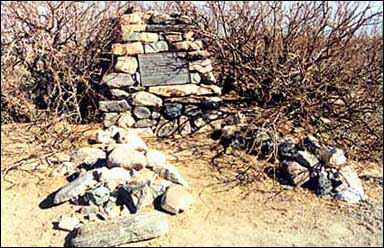
Shorty and Jim Dayton Graves, Death Valley
Here Shorty is buried. He died in Lone Pine in 1934, but as a last request his remains were buried next to his friend Jim Dayton, in the valley they had both come to love. He wrote his own epitaph, and it says it all:
"Bury me beside Jim Dayton in the valley we loved. Above me write: Here lies Shorty Harris, a single-blanket-jackass prospector."
